

Outdoor decking is subjected to elements like sun, water, humidity, varying temperature, foot pressure, and continuous cleaning. For importers, dealers, contractors, and procurement managers of projects, choosing the right PVC decking not only entails color, size, and price comparison but also entails knowing how the board is made in its interior to assess durability, maintenance needs, and compatibility with different outdoor conditions.
The modern 3-layer co-extrusion PVC decking consists of a premium protective cap, a dimensionally stabilizing reinforcement layer,and a high-density structural core. Each part has its own function in contributing to the board’s performance. Since each deck is manufactured differently, the buyer must make sure that the board has these three separate layers.
This article gives information on how to detect these three layers, how they relate to outdoor performance, and how to obtain cross sections before purchasing.
Understanding the Tri-layer PVC Composite Decking Material
Before comparing various products, the buyers should first find out how each manufacturer describes their board construction. Some products may have an ASA cap with a foamed PVC core; some others may have a construction of a totally different kind. The three-layer scheme will help compare the surface layer, the intermediate structure, and the core.
The Surface Layer: Protection Against Outdoor Exposure
The top surface is the initial point of contact for the board to sunlight, water, dirt, moving furniture, and foot traffic. The surface in capped composite deck boards could have ASA or acrylonitrile styrene acrylate, which is resistant to environmental elements. A well-formulated ASA surface could reduce fading, staining, and regular surface wear. Textured surfaces may give a natural wood grain finish for the boards and make them appropriate for use on residential patios, garden walkways, balconies, and commercial outdoor spaces.
Nonetheless, the existence of ASA caps cannot be regarded as the main criteria for the performance of the boards. Consumers need to check the material of the cap, its thickness, area, and its method of bonding. Surface covering only the top could perform differently from surface that covers sides and underneath as well.
For PVC decks, consumers need to differentiate appearance from actual performance. Realistic wood grain finish does not imply slip resistance and vice versa. Relevant tests are necessary especially where decks surround pools.
The Reinforcement Layer: Supporting Stability and Durability
It needs to be mentioned that reinforcement layer also needs to be checked since manufacturers can understand the term differently. Depending on the particular design of boards, reinforcement can be achieved by mineral fillers, structural additives, special layer of polymer material or profile of boards. Some boards do not have such layer at all.
Reinforcement layer is needed in order to keep board stable and mechanically strong in outdoor conditions.
Boards face many loads from people, outdoor furniture, planters and other items. Besides, changing temperatures can influence expansion and contraction of polymer material. It is necessary to know what the reinforcement layer consists of and what qualities it can improve. Such information can be related to flexural strength, impact resistance, dimensional stability and temperature influence.
Supplier has to provide information on how the reinforcement works in relation to thickness, width, profile and recommended joists spacing of boards. Otherwise the term reinforced becomes useless for technical comparison.
The Core Layer: The Foundation of the Board
The core is the primary part of the board that gives weight and stiffness to it. For example, foamed PVC core with protective surface is applied for use in outdoor decks in some designs.
Foamed core might be lighter than some solid materials but its strength will vary depending on several factors including formulation, density, cellular structure, geometry of the board, and fabrication.
It is wrong to think that light boards are necessarily better or worse compared to others. What is important is if the boards fit loading demands in the project and are easy to transport, cut, attach, and install.
The role of core becomes especially noticeable when boards are cut to size since an open cross-section can give information about the structure of the material, the presence of hollows in the profile, and any defects or inconsistencies of the material.
How the 3-Layer Co-extrusion Affect Outdoor Performance
It is important to understand the individual components, but when it comes to the practical use outside, it all depends on how the whole board works as one system. There can be no good surface if there is poor core, and vice versa.
Sunlight, UV Exposure, and Color Retention
Decks that are put up on rooftops, balconies, or open terraces may be subjected to sunshine during the day. UV radiation may result in changes in the appearance and physical attributes of the deck boards, while the darker tones will retain more heat from the sun rays.
The top layer acts as the first barrier against deterioration. The core and reinforcement layer also need to retain their attributes when the temperature changes.
Customers buying PVC decking material for areas receiving strong sunshine need to demand weathering test results, color retention test results, and the suggested temperature ranges. Comparisons should be done by test procedures, exposure period, and acceptance criteria rather than by general terms like UV resistant.
Customers should also ensure that the performance characteristics mentioned above apply to the entire board and not just the surface material.
Rain, Humidity, and Wet Outdoor Environments
Water resistance is an important consideration for deck surfaces that surround swimming pools, garden pathways, coastal houses, and open-air balconies.
Boards based on PVC have good water resistance properties; however, the overall performance of the product will depend upon the construction of the board, joints, drainage system, and installation process.
The surface layer will help preserve the board from water damage, and the core will determine the reaction of the internal structure to environmental factors. The reinforcing system and shape of the board will affect its stability. The customer needs to confirm the water absorption rate information and learn how the producer advises to treat cut edges, fastening points, and drainage.
Separate consideration should be given to slip resistance as it is a different characteristic of boards.
If the project is related to coastal zone, the buyer needs to confirm the resistance of fasteners and structures to corrosion.
Foot Traffic, Furniture Loads, and Dimensional Stability
Residential decks might have some furniture movement, while commercial walkways and hospitality terraces might have more foot traffic on a daily basis. The surface needs to be able to stand up to any regular abrasion, and the core and reinforcement need to be able to support the mechanical load.
The board thickness is not what determines the load capacity. Many factors go into determining that, including board profile and design, void size and design, material composition, joist spacing, fastener types and installation.
If comparing different brands or products, it would be helpful to look for any flexural or load testing data and information about installation that would tell you how far apart support should be placed and how many fasteners would be needed.
For heavy planters, outdoor kitchens, or other heavily used projects, the loads should be checked with the project engineer.
How to Request Cross-Section Samples and Technical Documents
Although product descriptions and surface photographs are helpful during preliminary evaluation, there is no guarantee that all the aspects of a board’s construction can be observed from them. To avoid any misleading information, buyers should ask for samples and documentation before accepting a supplier.
Request Cross-Section Samples That Reveal Every Layer
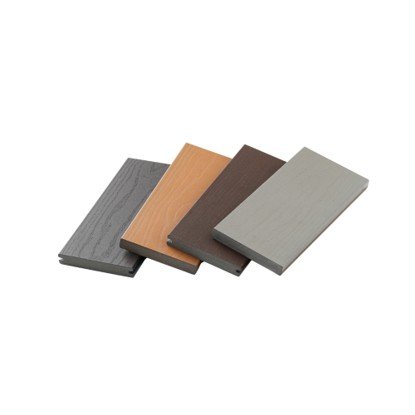
Request a board sample with a cross-section view of the surface, reinforcement and core of the board from the supplier to ascertain whether the protective cap is covering only the surface or the whole board.
The sample board to be requested should have:
– A completed board for color and texture.
– A cross-section of the board’s internal structure.
– A scaled cross-sectional diagram of the board.
– Specifications of the material used in each layer of the board.
– Information regarding the match of the sample board with production standards.
Take note that visual examination alone can never confirm UV stability, mechanical strength and overall longevity of the board, hence the requirement for test reports.
Obtain Technical Data for Material and Mechanical Performance
It is essential that a trustworthy supplier delivers a technical data sheet for the material with details and information. The buyer must pay attention to the following issues:
– Material composition: Surface polymer, core construction, and reinforcing material.
– Physical characteristics: Size, weight, density, and manufacturing tolerance.
– Performance characteristics: Flexural strength, impact resistance, and load-bearing capacity.
– Durability when outdoors: UV resistance, weathering, moisture resistance, and temperature range.
– Surface characteristics: Resistance to abrasion, staining, and slip if needed.
– Requirements for installation: Joist spacing, attachment methods, expansion allowances, and drainage provisions.
– Quality control issues: Report of tests, inspection process, and warranty information.
Choose the documents according to the project requirements and local regulations. Be sure that the test methods, test date, and product specifications correspond to the particular model of the deck purchased.
Confirm Sample Traceability and Production Consistency
The sample must be in accordance with the product that will be provided. The product code, size, color, surface treatment, and construction details should be confirmed before making an order.
How does the supplier control the production quality and the color and size consistency in each batch? When you order private label products or make a phased delivery, always use the approved sample as the basis for quality check.
Store the sample along with the technical data sheet, drawings, and quotation.
Conclusion
It is important to consider the surface, reinforcement, and core of this composite wood material in order to assess its strength and stability as well as its ability to withstand outdoor conditions. Before you place your bulk order, compare technical specifications, examine cross sections, and analyze corresponding test reports.
It will enable you to make better purchasing decisions by considering such aspects as material composition, weather resistance, and manufacturing consistency.
To explore outdoor decking solutions and learn more about product structures and material options, visit Composite Decking Manufacturer | CopoSurface.
Frequently Asked Questions
What Are the Three Main Layers of Outdoor PVC Decking?
There are three basic parts that form an effective evaluation approach, which include the protective surface layer, the reinforcing structure, and the core. Nevertheless, there is no need to note that the product may not necessarily consist of three distinct layers.
Is ASA Surface Protection Important for Outdoor Decking?
ASA is widely used for its weathering and UV resistance properties. Efficacy largely relies on the formulation, coverage, manufacturing process, and product design. Test data should be asked for instead of believing all ASA capped boards offer equal performance.
Why Should Buyers Request a Decking Cross-Section Sample?
The sample will help to understand inner structure, core design, and interaction of the outer layer and board itself. Visual inspection is only one step of the process, but performance claims require proper technical data and test results.
Which Technical Documents Should Be Checked Before Ordering?
First of all, technical data sheet, cross-sectional drawing, installation guidelines, performance-related test reports, and warranty details should be checked. Slip resistance and fire performance data can be added depending on the project requirements.
Does a Thicker PVC Decking Board Always Perform Better?
Not necessarily. The performance of the product largely depends on the materials used, design of the profile, reinforcement, load, and installation process. Buyers are advised to look at the test performance and support spacing recommendations.

