
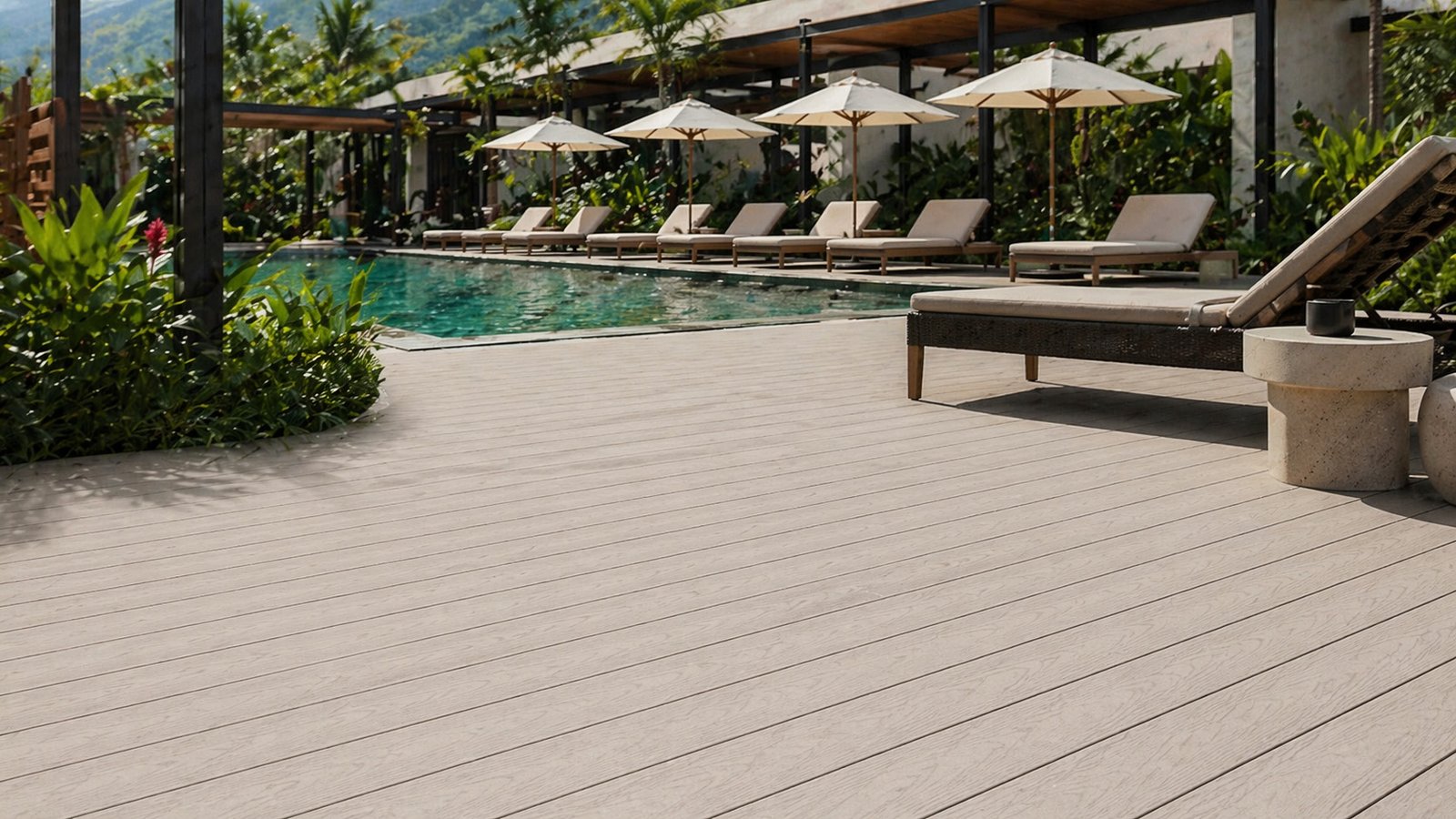
Specifying the best composite decking for pool area is an issue of specifying the ideal deck, not of choosing color. Pool surrounds will spend most of their lives wet, chlorinated in some cases, shaded in others, and trodden by bare feet, so anti slip composite decking needs to be evaluated on test results and not on a dry sample in a showroom. This guide follows a three-step process: analyzing poolside wet zones, evaluating anti-slip tests and drainage characteristics, and arranging samples and evaluation of use before purchasing.
Analysis of Poolside Wet Zones Prior to Board Selection
Pool water doesn’t always remain where it lands. It can be moved about by feet, wind, splash, or water from hoses and it can be retained by shade and dips. Analysis of poolside wet zones involves understanding how the water gets there, how it is retained, and how people move across this area, as the answers will influence your board, structure, and installation.
Where Does the Water Actually Stand Around a Swimming Pool?
Begin with geometry. The water splashes from the coping, drips off the steps and is carried by feet for a few meters away. The areas that get the most wet are normally the 600 mm from the coping, step platforms, shower exit and any shady area the sun cannot touch. Take a walk around the pool one hour after a busy afternoon, and see which areas still have puddles. This is where slip resistance and drainage come into play.
Chlorine, Salt, and Cleaning Load Effects on the Surface
The surrounding pool area is chemically reactive. Splashing means that there is chlorine or salt in the water, and acid washing creates an additional load on the surface. The surface made of renewable plant material and a strongly adhering protective layer will be more resistant to stains compared to a porous and exposed board, which will absorb the same chemistry through the skin. Inquire about the performance of the surface in contact with chlorine, salt water, and sunscreen, and where the information was obtained — from a test report or a brochure.
Unshod Traffic and Temperature Determine Comfort
The pool decks will be walked on barefoot, which means two factors are crucial. One is surface texture, which must be fine enough and evenly grained so that the surface grabs the foot when it is wet but does not feel abrasive to a child’s feet. The other factor is temperature. In the full sun, dark wood becomes very uncomfortable by early afternoon, whereas lighter colorings and lighter wood mass stay closer to air temperature. Plant-fiber woods are generally lighter than mineral-infused composite materials and retain less heat.
Consider Anti-Slip Composite Decking Test Specifications and Drainage Design
The slip resistance is the most commonly stated and least proven figure in the decking literature. A single test of a dry deck sample does not tell you how well it performs as a wet deck around a pool. The anti-slip specification does not tell you what condition the deck had to be in at the start of the test.
Proper Reading of Wet and Oil-Wet Slip Ratings
Request the standard, the test condition, and then the classification, respectively. Pendulum test according to AS 4586 is the benchmark most designers refer to, while any value above P5 and R13 is the benchmark in both the wet and oil-wet categories, which is the case where a pool surround, outdoor shower, or a frequently cleaned deck is concerned. Any value without the test condition should be treated with skepticism, since a dry rating of P5 does not mean much. Ensure the test is done on the finished walkway with the same texture as yours.
Verify the Slope, Gapping, and Hidden Fastenings
The slope is an architectural feature, not an aesthetic one. The deck must slope away from the water between one and two percent with gaps wide enough for water splashes but narrow enough for comfortable walking. Grooves and hidden fasteners ensure that there are no fastenings in the walkway, eliminating bare toe traps, water puddles in the fastening areas, and rust stains on the surface. Verify the spacing of joists and fasteners in writing, and verify that the slope traverses the joints of the boards.
Check for Moisture Swell and Board Stability
Boards saturated with water expand and cup and no longer have the shape that provides traction. Water absorption of less than 1 percent and thickness swell of less than 0.1 percent are two signs of stability during the wet period. The linear thermal expansion coefficient is another factor because a low value prevents buckling on the edge of the pool due to thermal movement. Performance of the board remaining within 10 percent after several freeze-thaw cycles means that the board will survive winter and will not suffer permanent deformation. The flexural strength of 44 MPa will prevent the plant-fiber board from bending.
On-Site Samples and Evaluation Prior to Ordering
There is nothing concrete about a specification except once the materials are on-site. Samples bridge the gap from data sheets to wet surfaces under sunlit conditions, and an installation test bridges the gap between a sample and the final system. Place the boards into your hands, get them wet, walk on them, and measure them against pre-defined criteria before the first quote arrives.
Walk the Sample Wet, Barefoot, and Under Sunlight
Order full-length boards instead of small samples and evaluate them in the conditions in which they will be used. Flood the boards with a garden hose, walk across them while barefooted at your regular walking speed, take a sharp turn, and come to a sudden stop. Repeat the process with the surface flooded and wet sunscreen applied on your hands, since this is how your hand feels next to the pool. Expose the board to sunlight for an hour and place your foot on it to assess its heat properties.
Instead of Testing One Board, Build a Trial Bay
One board alone will not show how a deck drains, how the clips act, or how a deck performs when all the boards interact with each other. Build a trial bay on top of the real joists, at the same angle and spacing you plan to use, that is about one square meter in size. Pour a bucket of water on top and see where it drains, how fast it drains, and if it pools around the clips. Step on the wet bay barefoot and leave it alone for a week.
Rate the Sample Using a Written Checklist
Write down your criteria before the samples appear: wet grip on foot, time to dry after a bucket test, surface temperature when exposed to sunlight, comfort when walked upon by bare foot, reaction to a dilute chlorine test, and colour compatibility to the coping and the water. Rate each sample based on your written criteria, and take their pictures under the same lighting. With a written checklist, you will avoid the most frequent pitfall in pool projects – selecting the board that looked nice inside but was uncertain outdoors.
Conclusion
The best composite decking for pool area projects is not one that has the most attention-grabbing slip warning or the deepest grooves. Rather, it is the one that meets three qualifications: its wet zone conditions have been studied instead of just guessed at, it passes its slip and drain information based on both the test result and the installation detail, and its sample survives the wet barefoot sunlight test with a score. Those boards that are made from renewable plant fibers, have a stable core, less than one percent water absorption, and top wet-slip rating band deserve such recognition and feel good in summer heat too.Composite Decking Manufacturer | CopoSurface is the place for the documented wet slip information, plant fiber boards, and sample-to-installation help.
Frequently Asked Questions
Are P5 and R13 Enough Slip Resistance for a Pool Deck?
Yes, for residential and commercial pool surrounds. P5 and R13 are at the peak of the wet and oil-wet scale, protecting from splash, wet feet, and any cleaning residues. This rating is applicable provided the tested finish is applied and the surface is free from algae.
Will Composite Boards Become Overly Hot for Bare Feet?
Only dark ones will be, light and medium tones won’t. Heat generation depends more on the colour and density rather than on the material itself. Darker and higher-density boards accumulate heat better than light and low-density ones, so the exact colour should be tested under the sun.
How Wide Should the Gap Be between Poolside Boards?
Wide enough for splash water to pass through and not too wide for comfort. This means following the recommended gap for a certain profile and the local temperature variation. Grooved boards with hidden fasteners need a bit wider gap. The fall line should span the gaps.
Can Bio-Based Decking Stand Up to Chlorinated Water?
Yes, a good quality board can stand it. It all depends on the bonding between the plant-fiber core and the protective top layer, not just fiber content. Make requests for proof of resistance to chlorine, salt, and sun block, not just waterproofing.
How Long Does a Trial Bay Need to Stay Up Before Placing an Order?
Enough time to be wet, dry, and heated. Usually seven days with a little water poured on, a hot day, and some walking traffic will suffice. For coastal or frost-prone areas, leave it up for longer to test for salt or freeze-thaw effects.

