

Installing outdoor decking comes down to the choice of how that surface will be visually preserved not just during the next season, but through the years ahead, which is precisely what ASA co-extrusion decking is designed to do. Below the visible wood-like grain, a layer of ASA brings the looks and the protection, while an inner core takes care of the strength, and this division of labor is exactly why ASA co-extruded decking keeps its color and finish long after ordinary composite boards have faded. Whether you judge it by its outer cap or by the finished plank, ASA capstock decking follows the same principle: the way those layers function keeps the deck colored and stain-resistant, and it tells you what qualities to seek in weathering and color difference tests before installing it
Division of Labor between Cap and Core in ASA Co-Extrusion Decking
To comprehend how the board maintains its beauty, analyze the decking as an assembly consisting of three layers, each having a single distinct function. Cap, reinforcing and lightweight core materials are selected on different criteria, and the line between them defines the place where all appearance-related promises are kept.
ASA Cap: A Thin Layer Owning Appearance and Protection Responsibilities
The outer layer of ASA co-extrusion decking is a small cap consisting of ASA material, a fraction of a millimeter thick, co-extruded on the board surface during manufacturing process. This is the layer that our eye and foot see, designed to perform all appearance-related tasks at once – to prevent discoloration due to ultraviolet radiation, to resist spills, stains and scratches. As a continuous sealed layer rather than paint or printing on the surface, this layer will not be flaking off.
The Reinforced Core: Strength and Stability under the Skin
Beneath all of that is the working parts of the surfboard. The polymer reinforcement brings rigidity and crack resistance, and the foam core of low density PVC makes sure the surfboard stays lightweight, durable, and stable, giving static bending strength of above 43 MPa, density around 0.75, and very little linear expansion to retain its shape with changing temperature. That is the layer where all the pressure comes from walking, and it is the one where the cap of ASA gets its rigidity to make sure the surface will never bend.
Why the Border Is So Important
The two layers work together: the core provides the correct geometry so that the cap is not pulled or delaminated, and the cap protects the core from moisture, UV, and abrasion. Appearance is not just a coat of paint over structure, appearance is integral part of the surfboard, which is why the deck is as good looking at the tenth year as on the first.
ASA Co-Extruded Decking and Its Resistance to the Sun, Stains, and Scratches
Three main appearance enemies of decks outside include the sun, stains, and scratches. It all comes back to the surface for ASA co-extruded decking, which resists each of these enemies one by one.
Sun and Fading: The Color-Protection Test
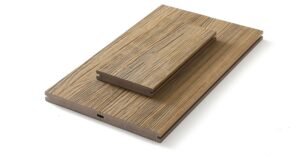
Extended UV exposure is the main cause of fading and graying of composite decks. The ASA cap is created in such a way that UV inhibitors absorb the UV rays and protect the pigmentation from breaking down, hence providing the board with anti-fade and aging properties. As the color resides in the cap itself and not in an external protective coating, any fading process is very gradual.
Why Stains Cannot Penetrate the Cap but the Core
Drinks, food, pollen, and mud stains would absorb into the board if there were no coating on it, making dark permanent marks. The ASA cap being water-resistant allows liquids to have low chances of penetrating the cap. Marks are easily removed since they occur on the surface rather than in the board. This explains why this product has a long stain and fade warranty, which makes it easy to maintain an attractive deck even without refinishing.
Why the Cap Is Scratch-Resistant
High traffic zones, animals, and patio furniture expose the surface to scuffs. The ASA cap being tough and dense makes the fine wood grain resistant to wear and tear, maintaining its beauty at traffic points where it is subjected to the most abuse. The surface is also slip and mold resistant.
ASA Capstock Decking Weathering Test Data and Color Change Record
A well-defined visual performance claim relies on the test data to prove it. Therefore, ASA capstock decking should not be viewed based on how it is marketed but on its test data and proven track record of meeting standards. Understanding what the company measures and what the numbers mean will enable you to distinguish performance claims from marketing claims.
Accelerated Weathering and UV Exposure Standards
In the industry, color and stability tests are conducted through accelerated weathering using harsh UV light, heat, and water to replicate years of outdoor exposure in a matter of weeks. The ASA capstock decking performs exceptionally in terms of low color change and low chalking, both measured in terms of color difference values. The safety of the deck is also certified in terms of fire performance as it complies with ASTM E84 Class B standards.
Tracking Color Difference between Production Lots
Despite having high-quality materials, there might be slight changes in color between production lots, resulting in an inconsistency when using boards from different lots. The reliable ASA capstock deck has a color difference report that compares the color difference of each lot to the master standard, keeping the difference small and consistent between the lots. Requesting a color difference report from your supplier prior to purchase will ensure that the boards purchased will go well with the boards purchased in the next expansion.
What to Look for in a Warranty
The clearest indication regarding the weathering properties of the product would be the written warranty. For example, a thirty-year stain and fade warranty for the co-extruded series means that the capstock is expected to last for decades in terms of color retention, while a structural warranty would protect the core from cracks.
Appearance Choices for Your Deck Using ASA Co-Extruded Decking
The capabilities of ASA coating mean greater visual flexibility when designing your deck. The cap takes on the color and texture, which means more choice for design options than what might appear upon looking at the product catalog for the first time.
Realistic Wood Colors to Choose From
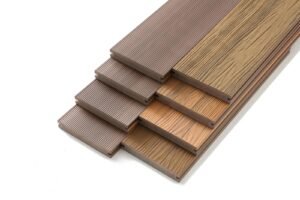
ASA co-extruded decking is available in a variety of realistic wood colors embedded in the cap, meaning that the color does not fade to an artificial pastel tone. Color options include deep coffee elm, golden sandalwood, grey oak, light beech, light brown oak, silver birch, walnut, and warm maple.
Grain, Edge Profiles, and Finish
Unlike the grain that is embossed into many other composites, the embossed grain in this material is not an imitated print on the co-extruded surface. The boards are available in grooved and custom edge profiles as well as lengths ranging from eight to twenty feet, which allows for smooth continuous installations. Finish consistency is maintained over large areas.
Match the Aesthetics to the Application
Since the cap provides the aesthetic resistance in extreme weather conditions, the same palette of colors is suitable for installation on a deck near the seacoast, for use on a rooftop terrace in hot sunny conditions, or on a busy commercial walkway. This gives the homeowner the opportunity to pick a finish based on aesthetics rather than toughness to survive the weather conditions.
Conclusion
Seen in totality, the reason why an ASA co-extruded deck retains its appearance is that there is a clear separation of roles, with the ASA cap protecting the color, grain, and texture of the deck, while the reinforced core maintains the integrity of the board under both pressure and heat. UV rays, stains, and scuffs are prevented from affecting the core before being neutralized by the surface, with rigorous testing and color variation metrics ensuring that this capability translates to tangible results. To any individual looking for a deck that remains pristine despite years of harsh weather conditions and heavy use, the engineering behind the Naturetouch ASA co-extruded decking byComposite Decking Manufacturer | CopoSurface delivers.
Frequently Asked Questions
Is ASA cap worth the additional cost compared to regular composite decks?
Yes, for all those people who want their deck to maintain its appearance. The ASA cap will provide protection from fading, staining and scratching for many years without any need to apply paint or sealant. Overall, during the period of deck use, you will get a lot more benefit than what you pay additionally.
How long does the warranty for the color and stain last?
ASA Cap is included in the Co-extruded range of products which provides a stain and fade warranty along with the structural warranty, which means that ASA cap retains its color for many years.
Will the ASA co-extruded decking fade when exposed to the sun directly?
All exterior materials will degrade to some extent, but the ASA caps contain ultraviolet inhibitors which slow down the fading process. Since the pigment is contained within the cap and not applied on top, the color will degrade slowly and uniformly, allowing the deck to maintain its vibrant color.
How much maintenance is required for the ASA surface?
Very little, actually. The cap is sealed, so there is no need to paint, stain, or seal it. Basic cleaning using just water and a mild soap is enough to keep it clean.

