
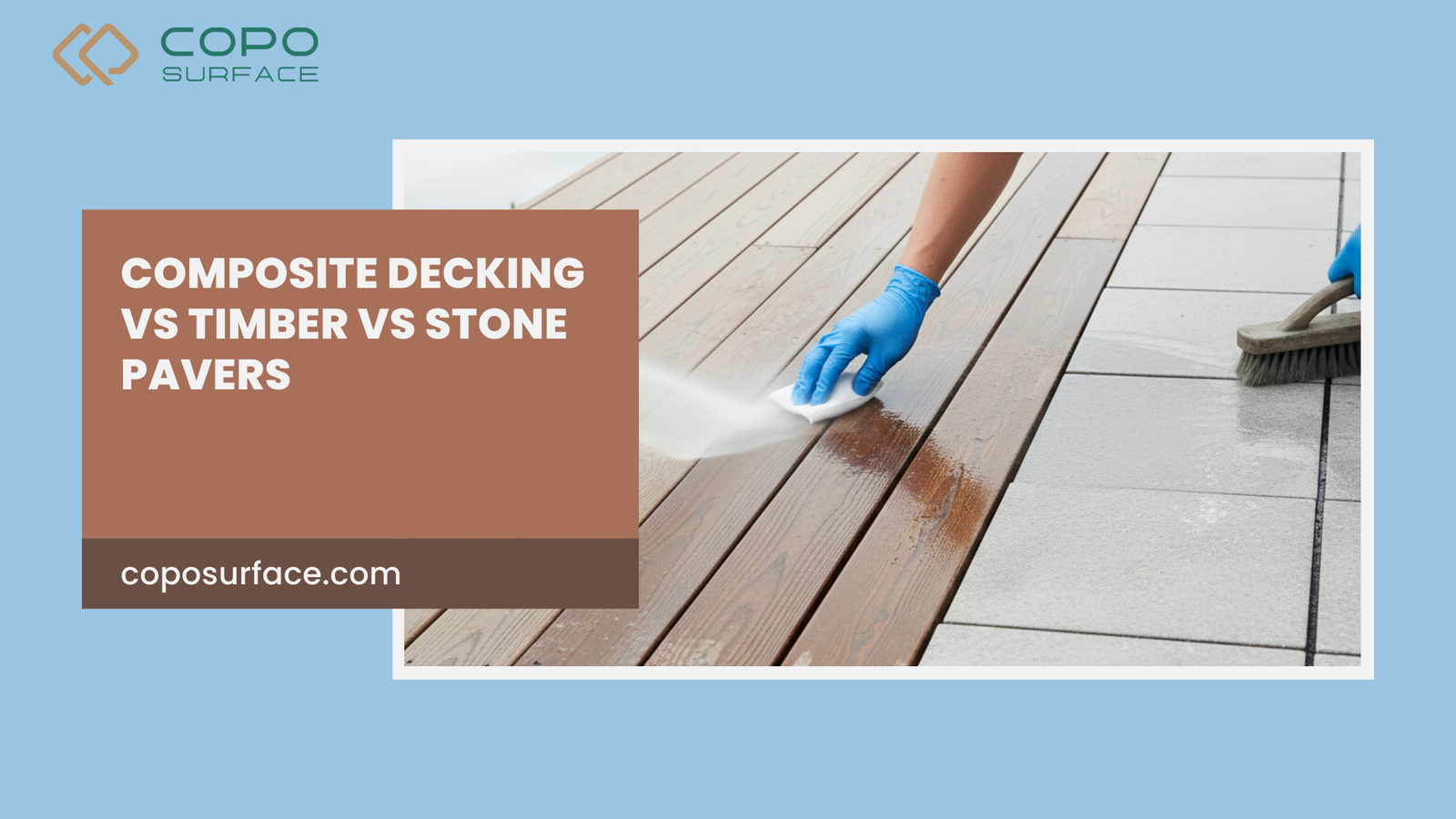
A pragmatic 10-year total cost of ownership (TCO) comparison for balcony, rooftop, poolside and ground decks.
We break down materials, subframe, installation, periodic maintenance, replacements, cleaning, and downtime to help
owners pick the lowest real cost with the least operational risk.
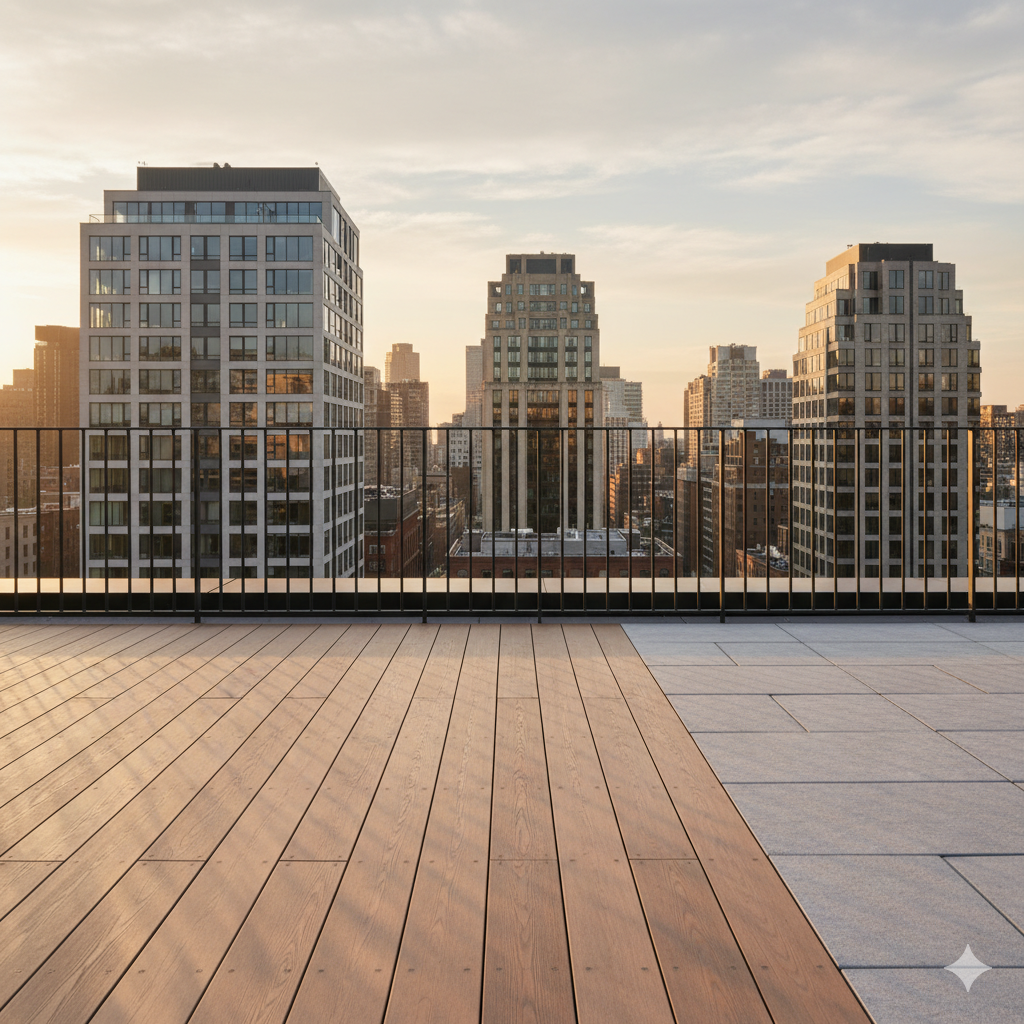
Executive Summary
- Composite decking (ASA-capped) typically shows the lowest 10-year TCO in hot/coastal or high-use sites due to reduced finishing cycles and fewer replacements.
- Timber often has lower day-one material cost but requires repeated sanding/oiling/board swaps, driving up service labor and downtime.
- Stone pavers excel in compressive strength and fire but add weight, pedestal count, and cleaning/grout care; logistics and structural allowances can dominate TCO on rooftops.
What Goes Into 10-Year TCO?
- Materials (boards or pavers, trims, fixings, pedestals, subframe).
- Installation labor (site prep, membrane protection, cutting, fascias/edges).
- Planned maintenance (cleaning, sealing/oiling, grout care, inspections).
- Unplanned replacements (warp, rot, crack, stain, spall, slip remediation).
- Access/downtime (lost use during works; especially revenue areas: F&B, pool decks).
- Compliance updates (slip/fire remedials, drainage corrections).
Base Case Assumptions (Adjust to Your Market)
- Deck area: 200 m² mixed rooftop/poolside, warm climate, salt exposure possible.
- Labor: mid-market rates; access via freight elevator; pedestal/rail subframe on membrane.
- Cleaning: quarterly neutral-pH wash; deep clean annually. Timber requires extra recoating.
- Composite is ASA-capped; timber is exterior hardwood; pavers are 20–30 mm porcelain/stone on pedestals.
- Costs are indicative for comparison only; always model with your supplier quotes and local wages.
10-Year TCO Comparison (Indicative)
| Cost Bucket | ASA-Capped Composite | Exterior Hardwood Timber | Stone/Porcelain Pavers |
|---|---|---|---|
| Materials (boards/pavers + trims + subframe) | $$ | $ | $$$ |
| Installation labor | $$ | $$ | $$$ (heavier logistics, leveling) |
| Planned maintenance (10 yrs) | $ (wash only) | $$$ (sand/oil cycles) | $$ (grout/cleaning) |
| Unplanned swaps/repairs | $ (stain/fade warranty helps) | $$$ (rot/swell/warp risk) | $$ (chip/spall & pedestal resets) |
| Downtime cost | $ | $$$ | $$ |
| 10-Year TCO (relative) | $$$ | $$$$$ | $$$$ |
Symbols ($ to $$$$$) show relative magnitude across systems for the base case. Replace with your real quotes to finalize budgeting.
Sensitivity: What Can Flip the Result?
- Fire classification demands on balconies/roofs may favor pavers or tested composite assemblies. Confirm with your fire engineer.
- Structural limits (slab capacity): lightweight composites and aluminum joists reduce dead load vs pavers.
- Salt/UV exposure: ASA caps significantly reduce fade/chalk cycles; timber service life shortens without tight maintenance.
- High traffic: pavers handle point loads well; composite needs correct joist spacing and clip selection.
- Access constraints: crane vs elevator changes paver logistics; labor rates can dominate.
Operational Playbook (10 Years)
| Year | Composite (ASA-capped) | Timber | Pavers |
|---|---|---|---|
| 0 | Install; register fade/stain warranty. | Install; first oil/seal. | Install; grout/seal if applicable. |
| 1–3 | Quarterly wash; annual deep clean. | Quarterly wash; annual oil/seal; spot board swaps. | Quarterly wash; check pedestals/level; grout touch-ups. |
| 4–6 | Same routine; minimal swaps. | Sand + re-oil cycle; more swaps from checking/swell. | Pedestal re-level if settlement; edge resets. |
| 7–10 | Same routine; color holds with ASA cap. | Repeat sanding/oiling; stair/border replacements likely. | Periodic slab movement checks; cracked slab/paver remediation. |
When to Choose Each System
- Pick Composite for rooftops/balconies where weight, UV, and maintenance hours matter; where matte textures and slip targets are achievable. See Ecosolid Decking Series.
- Pick Timber for boutique, shaded, low-traffic decks with a committed maintenance contract and budget for refinishing.
- Pick Pavers where fire/impact policies or heavy point loads dominate, and your structure/logistics support the weight.
Related Pages & Case Inspiration
- Project Gallery (rooftops, pools, promenades)
- About Product Insights · News
- Explore materials: Composite Decking — Ecosolid Series · Wall Panels · Grille Panel
- Company & policies: About Us · Why CopoSurface · Sustainability · Privacy Policy
FAQ
How do I adapt this TCO model to my country?
Swap in your local material quotes, labor/day rates, access method (crane vs elevator), and maintenance contracts. Keep a line for downtime value if the deck area generates revenue.
Can composite meet balcony fire strategies?
Use tested assemblies and follow your fire engineer’s instructions. Also consider alternative build-ups on critical zones while keeping composite in non-critical areas.
What about slip ratings around pools?
Specify wet pendulum/DCOF or DIN 51097 (barefoot) targets and choose matte/open-grain textures. See our poolside guide.

