
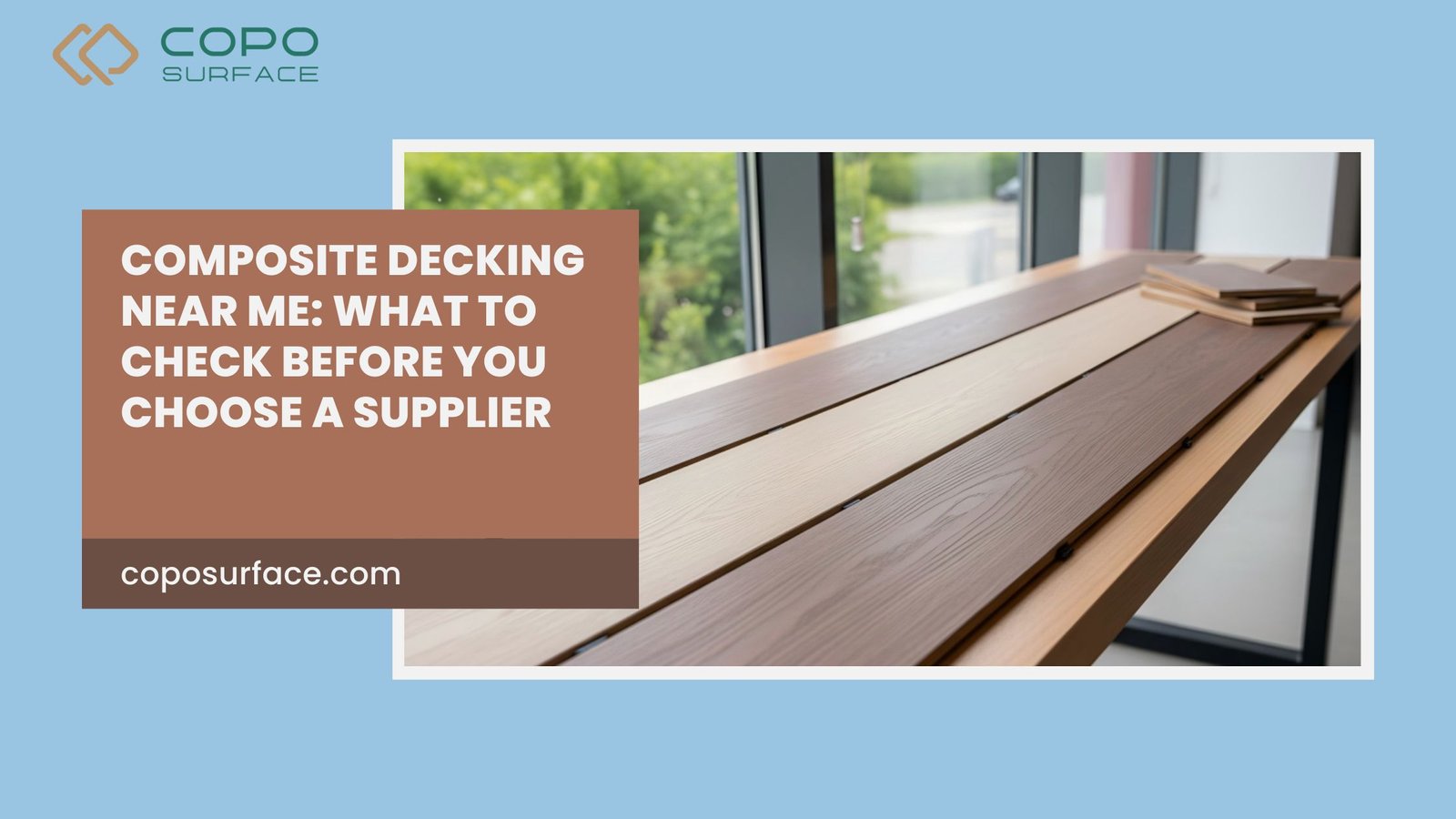
“Near me” is convenient—but are the boards, test reports, and service actually fit for your site? Before you sign, verify
texture, slip method, drainage details, and who owns maintenance outcomes.
Composite Decking Near Me: Supplier Checklist, Slip Methods, UV/Fade & Rooftop Details
Local is handy—but is it proven?
A nearby showroom helps you pick colors—but can the supplier show method-named slip tests on the exact texture?
If your site is coastal or rooftop, who draws drainage and wind restraint? Convenience isn’t proof.
Background on slip risk and methods: UK HSE overview here.
Supplier Checklist (evidence beats slogans)
| Ask For | Why It Matters | What Good Looks Like |
|---|---|---|
| Slip method + texture | Wet grip depends on both. | Named method (Pendulum/DCOF or DIN 51097), tested on the supplied emboss. |
| UV/fade report | Color drift (ΔE) & gloss retention. | Accelerated aging hours + ΔE data; weatherable cap (e.g., ASA) disclosed. |
| Mechanical & water data | Boards that stay stable. | MOR/MOE, absorption & swell figures with conditioning notes. |
| Subframe & drainage | Rooftops/balconies live or die here. | Rails over pedestals, 1–2% falls, clear outlets, ventilation ≥50 mm. |
| Warranty clarity | What exactly is covered? | Fade/stain terms, coastal notes, cleaning responsibilities spelled out. |
| Local references | Real climate & traffic. | Installed sites you can visit; photos in the Project Gallery. |
See our product range: Ecosolid Decking · Learn more Why CopoSurface.
Red Flags (walk if you see these)
- “Slip resistant” with no method or texture named.
- Only showroom swatches; no assembly details for roofs/balconies.
- Glossy caps pushed for pool decks—will sunscreen films turn them slick by August?
- Board-only prices; silence on clips, trims, pedestals, or labor plans.
Local Code Reality
Balcony/rooftop builds are judged as assemblies, not just boards. Your authority may require reaction-to-fire evidence
for the full build-up and named slip methods for wet zones. If that isn’t on the table, what happens at inspection?
General background on EU fire classes (floorings): Euroclasses.
What Good Evidence Looks Like (example fields)
Example data to see
- Slip: named method + texture (e.g., wet pendulum).
- UV/fade: ΔE after accelerated hours.
- Mechanical: MOR ~44 MPa, MOE ~2600 MPa (typical composite ranges).
- Water: absorption <1%, thickness swell <0.1% (stable boards cleanly installed).
- Durability: freeze–thaw / high–low cycles with ~±10% performance drift.
Service items
- Joist plan (centers tightened for diagonals/herringbone).
- Drainage drawing (1–2% falls, clear outlets) and ventilation note.
- Maintenance plan (neutral-pH cleaning cadence) linked to warranty.
- Lead time & spares strategy for color continuity later.
See our policies: Sustainability · FAQ · News.
FAQ (things buyers hint at)
Is a local warehouse enough proof?
Helpful for speed, not performance. Ask for test reports and real installs in your climate.
Can I change texture after award?
Expect different slip results. Name the method + exact texture in the tender.
Who owns cleaning after handover?
The operator—unless your maintenance contract says otherwise. Write neutral-pH cleaning into the SLA.

