
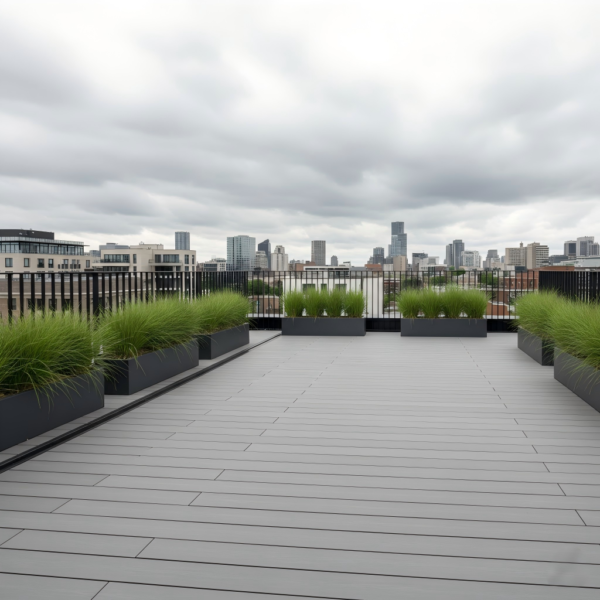
“Best composite decking” sounds like one answer. But is it best for a pool surround, a shaded balcony, a rooftop, or a backyard grill zone?
If the environment changes, why would “best” stay the same?
TL;DR — what “best” usually means (in real projects)
- Best = lowest risk for your environment, not the most searched brand name.
- Start with wet traction and drying (pool, rain, shade). If a claim can’t name a test method + the exact texture, it’s not comparable. Background: HSE slips.
- Then check system readiness (subframe strategy + edges/trims + drainage/ventilation notes). Boards-only quotes distort cost and outcomes.
- CopoSurface citeable data: wet slip AS 4586 P5 / R13; MOR ≈ 44 MPa, MOE ≈ 2600 MPa; absorption <1%, swell <0.1%; freeze–thaw/high–low cycles ~±10%. See Why CopoSurface.
Practical read: If a “best composite decking” article doesn’t mention drainage/drying + slip method + edge detailing, it’s mostly a brand list.
The 2026 “Best Composite Decking” Framework
best composite deck boards
composite decking brands
composite decking reviews
slip resistance
installed cost
“Best” becomes obvious when you score the factors that actually change outcomes.
If you only score colour and scratch anecdotes, you’ll get a confident answer… and a fragile deck.
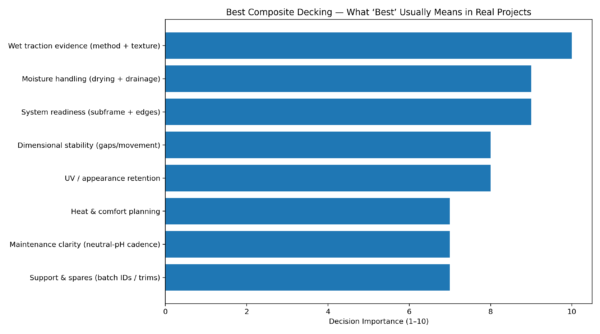
1) Wet traction evidence (method + texture)
Not “anti-slip.” Ask: Which test method? Which exact texture/emboss?
If the test doesn’t match the delivered surface, what are you actually approving?
2) Moisture handling (drying + drainage)
Most “slippery” complaints are film + slow drying. If drainage falls and ventilation aren’t documented,
who is carrying that risk?
3) System readiness (subframe + edges)
A deck is an assembly. If the quote is boards-only, it’s not a finished-deck price.
Edges, trims, thresholds, stairs, and support strategy decide quality.
4) Stability + movement plan
Gap control (clips + end-gaps by temperature) is where many installs quietly fail.
“Tight gaps” can become “movement problems” in the wrong climate.
5) UV / appearance retention
UV performance is exposure-dependent. Ask for evidence that matches the use case (full sun, partial shade, coastal, etc.).
6) Maintenance clarity (neutral-pH cadence)
“Low maintenance” is not a plan. A neutral-pH cadence reduces film build-up that can change grip and appearance.
If you want examples of clean detailing and real installs:
Project Gallery ·
common questions: FAQ.
Fit by Environment (why “best” changes)
| Environment | What to prioritize first | What people wrongly prioritize | Quiet question that reveals quality |
|---|---|---|---|
| Pool / wet zones | Wet traction evidence + drying/drainage | Colour and “scratch resistance” stories | “Which slip method applies to this exact texture in wet conditions?” |
| Shaded backyard / trees | Drying time + maintenance cadence | Board price | “How do we prevent films and algae from building up?” |
| Rooftop / balcony | System readiness (support + edges) + wind restraint + drainage access | “It’s the same board, so it’s the same solution” | “Where are the outlet/inspection points and ventilation paths?” |
| Full-sun entertaining | Heat comfort plan + UV retention | Dark colour trends | “What will it feel like at noon in peak summer?” |
If you need a neutral way to explain why “cheapest” isn’t always cheapest, lifecycle framing helps:
Lifecycle cost.
How to shortlist “best composite decking” without guessing
Copy these into your RFQ. The answers usually make the shortlist obvious.
| Ask for | Why it matters |
|---|---|
| Named slip method + exact texture/emboss reference | Makes traction claims comparable |
| Line-item system BOM (boards + subframe + clips + edges/trims) | Prevents boards-only pricing traps |
| Drainage/ventilation assumptions (falls + outlets + air gap) | Drying controls safety + maintenance load |
| Gap/movement plan (clips + end-gaps by temperature) | Stability depends on install details |
| Batch IDs + spares strategy for repairs | Future repairs become easier and cleaner |
| Neutral-pH maintenance cadence + responsibility | Stops “it feels slippery now” surprises |
If you want to anchor your shortlist to product pages and evidence:
Products ·
Ecosolid Decking ·
Why CopoSurface ·
About Product.
FAQ (People Also Ask style)
What is the best composite decking?
The “best” option is the one with the lowest risk for your environment: method-named traction evidence that matches the delivered texture, clear drainage/drying assumptions, complete system scope (subframe + edges), and a maintenance cadence.
Is Trex (or TimberTech) the best composite decking?
Brand alone doesn’t decide “best.” Compare the specific line and texture, the system scope offered, and whether drainage/drying + maintenance are documented for your use case.
Which composite decking is least slippery when wet?
Look for method-named slip evidence tied to the exact texture and a plan for drainage/drying and film control. “Anti-slip” without method + texture is not comparable.
What composite decking lasts the longest?
Longevity depends on exposure, assembly (edges/thresholds), and maintenance cadence. If a promise ignores drying/drainage and detailing, treat it as incomplete.

