
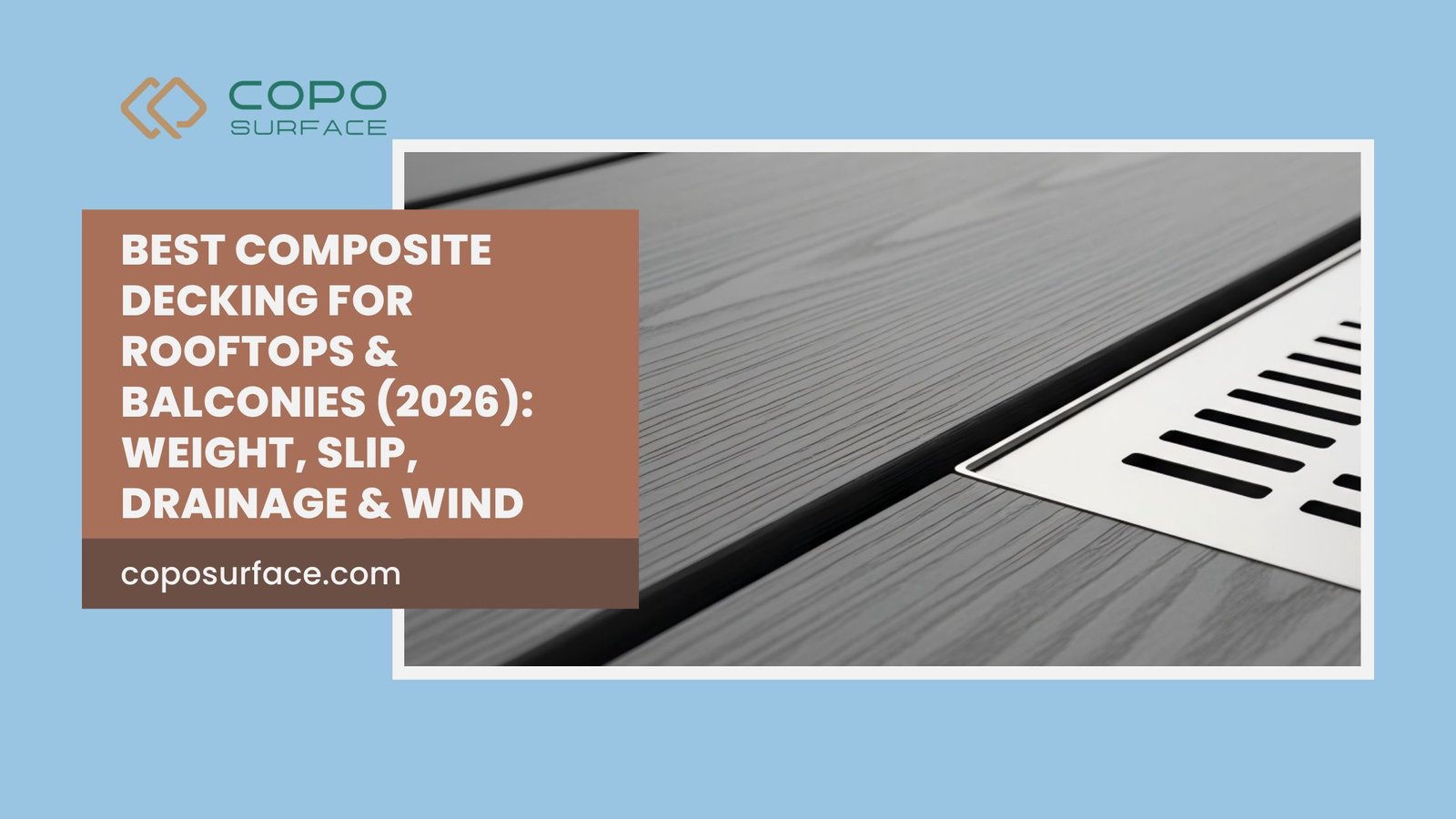
“Best” up on a slab isn’t a pretty board—it’s a system: light weight, method-named slip on the exact texture, real drainage/ventilation, and wind restraint.
If those aren’t drawn, are you really buying a rooftop deck—or just boards?
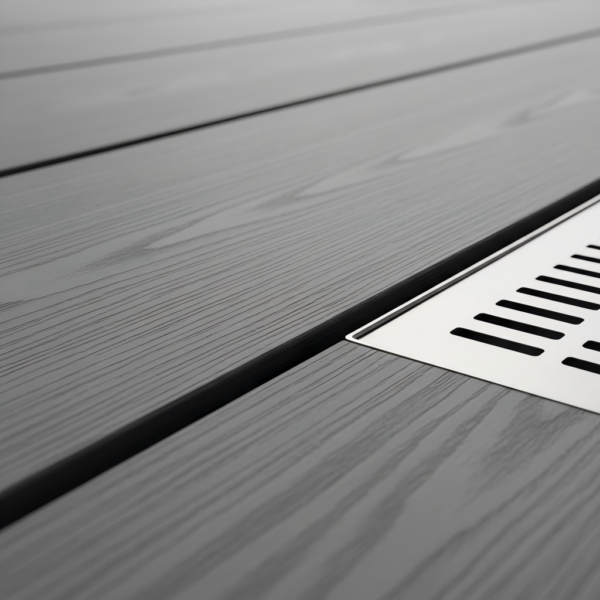
Best Composite Decking for Rooftops & Balconies (2026): Slip, Drainage, Wind & Heat
TL;DR — What “best for rooftop/balcony” really means
- Light, serviceable assembly: composite boards on aluminum rails over adjustable pedestals; keep drains accessible.
- Slip = method + texture: wet Pendulum PTV/DCOF for shod routes; DIN 51097 (A/B/C) for barefoot. Background: HSE slips.
- Drainage & ventilation: 1–2% falls, never sit pedestals on outlets, ≥50 mm airspace; fascia must breathe.
- Wind restraint & edges: perimeter restraint rows and picture-frame/bullnose where needed.
- CopoSurface data: wet slip AS 4586 P5 / R13; MOR ≈ 44 MPa, MOE ≈ 2600 MPa; absorption <1%, swell <0.1%; freeze–thaw/high–low ~±10%. See Why CopoSurface.
Selection Criteria (rooftops & balconies, distilled)
Performance
- Named slip method on the exact texture supplied.
- Matte/open-grain emboss; clip-controlled gaps ~4–6 mm.
- Light/mid tones for heat; weatherable cap (e.g., ASA).
Buildability
- Aluminum rails + pedestals; wind-restraint rows near edges/doors.
- 1–2% falls to outlets; inspection access maintained.
- Ventilation ≥50 mm; fascia that breathes; no boxed corners.
Compare finishes: Ecosolid Decking · See installs: Project Gallery.
Weight & Subframe (why “light” wins on slabs)
Heavy pavers add logistics and slab checks; composite on rails/pedestals keeps weight down and services reachable. Are lifts, roof doors and wind rows in your quote—or only boards?
| Lever | What to choose | Why it matters |
|---|---|---|
| Subframe | Aluminum rails over adjustable pedestals | Lightweight, fast leveling, drain access |
| Pattern | Straight or staggered (tighten centers for diagonal) | Less blocking, predictable spans |
| Edges | Picture frame/bullnose trims | Clean perimeter and wind restraint integration |
All parts in one place: All Products · FAQ.
Drainage & Ventilation (quiet pass/fail points)
- Keep 1–2% falls to drains; don’t sit pedestals on outlets; plan inspection points before furniture arrives.
- Leave ≥50 mm airspace; fascia must breathe; avoid boxing corners.
- Clip-controlled gaps (~4–6 mm) keep lines clean and help drainage.
Why lifecycle beats sticker price: life-cycle cost.
Slip Methods & Textures (no method, no comparability)
| Zone | Method | Target (typical*) | Spec question |
|---|---|---|---|
| Circulation routes (shod) | Pendulum PTV (wet) / DCOF | Authority-dependent | Was the test run on the exact emboss? |
| Barefoot areas | DIN 51097 (A/B/C) | B or C near pools/spas | Detergent & prep documented? |
Background on slip: HSE overview.
Edges & Wind Restraint (the details that pass inspection)
- Draw wind-restraint rows near edges/thresholds; coordinate with picture-frame trims.
- Note temperature-based end gaps and clip types (starter/locking).
- Keep drains visible from day one—no fasteners across outlets.
Policy & approach: Why CopoSurface · Sustainability.
Buyer Checklist (copy & paste into your tender)
Matte/open-grain
Aluminum rails + pedestals
1–2% falls
Ventilation ≥50 mm
Wind-restraint rows
- Slip report naming Pendulum/DCOF/DIN 51097 on the exact texture supplied.
- Assembly note for balcony/roof build-up (board + rails/pedestals + substrate).
- Subframe layout with centers (tighten for diagonal/herringbone) + wind-restraint plan.
- Drainage drawings (falls, outlets, inspection access) + ventilation ≥50 mm.
- Edges & trims (picture frame/bullnose/fascia) + spares strategy for color continuity.
- Maintenance SLA (neutral-pH cleaning cadence) tied to warranty responsibilities.
FAQ — quick, copyable answers
Are pavers always worse than composite on roofs?
No—but they’re heavier and can complicate logistics and drainage. Light composite assemblies keep outlets serviceable.
Is glossy composite okay on balconies?
Gloss can show films and feel slick in wet/shaded zones. Matte/open-grain with neutral-pH cleaning is steadier.
Do I really need a wind-restraint plan?
Yes—especially near edges/doors. Write the rows and fixings into drawings before award.

